Egyptology ASU

This website explains the history of the kings of ancient Egypt and all information about the 30 Dynasties. This website created by: Fatma Younis Mohamed

Egyptology ASU
  • Home
  • Contact Us
  • About Us
  • Privacy Policy
  • Chronology
    • ARCHAIC PERIOD 3100 - 2686 BC
      • 1st Dynasty
      • 2nd Dynasty
    • OLD KINGDOM 2686 - 2181 BC
      • 3rd Dynasty
      • 4th Dyansty
      • 5th Dynasty
      • 6th Dynasty
    • 1ST INTERMEDIATE PERIOD 2181 - 2055 BC
      • 7th Dynasty
      • 8th Dynasty
      • 9th Dynasty
      • 10th Dynasty
    • MIDDLE KINGDOM 2055 - 1650 BC
      • 11th Dynasty
      • 12th Dynasty
    • 2nd INTERMEDIATE PERIOD 1650 - 1550 BC
      • 13th Dynasty
      • 14th Dynasty
      • 15th Dynasty
      • 16th Dynasty
      • 17th Dynasty
    • NEW KINGDOM 1550 - 1069 BC
      • 18th Dynasty
      • 19th Dynasty
      • 20th Dynasty
    • 3rd INTERMEDIATE PERIOD 1069 - 747 BC
      • 21st Dynasty
      • 22nd Dynasty
      • 23rd Dynasty
      • 24th Dynasty
      • 25th Dynasty
    • LATE PERIOD 747 - 332 BC
      • 26th Dynasty
      • 27th Dynasty
      • 28th Dynasty
      • 29th Dynasty
      • 30th Dynasty
    • funerary Texts
    • Sub Menu 4

The 17th dynasty “1585-1549” 

  • The history background:  
The 17th dynasty back to the 2nd intermediate period in the ancient Egyptian history. The kings ruled in upper Egypt at this period. Some mainstream scholars have suggested that the Seventeenth dynasty of Egypt had Nubian ancestry due to the expanded presence of Nubians in Egypt during that time and the craniofacial evidence from X-ray examinations of some members of this dynasty such as Seqenenre Tao and Tetisheri who displayed strong affinities with contemporary Nubians as the Hyksos ruled the lower Egypt in the same time. The last two kings of the dynasty opposed the Hyksos rule over Egypt and initiated a war that would rid Egypt of the Hyksos kings and began a period of unified rule, the New Kingdom of Egypt.

 The 29th Dynasty “399:380”  

The Historical Background:  

The Twenty-ninth Dynasty of Egypt (notated Dynasty XXIX, alternatively 29th Dynasty or Dynasty 29) is usually classified as the 4th Dynasty of the Ancient Egyptian Late Period. It was founded after the overthrow of Amyrtaeus, the only Pharaoh of the 28th Dynasty, by Nefaarud I in 398 BC, and disestablished upon the overthrow of Nefaarud II in 380 BC.  


 the rulers of the Twenty-Ninth or Mendesian Dynasty were:  

  • 1- Nef'aurud I (Nepherites I) 399-392 BC

The statue of Nepherites I  

It is believed that Nepherites was a general from the deltaic city of Mendes who, in the autumn of 399 BC, rose against pharaoh Amyrtaeus, defeated him in open battle, and then executed him at Memphis. Nepherites then crowned himself pharaoh at Memphis and possibly also at Sais, before shifting the capital from Sais to his hometown Mendes. The fact that Nepherites I chose the same Horus name of Psamtik I and the Golden Horus name of Amasis II – both relevant rulers of the earlier 26th Dynasty - is thought to demonstrate that he wanted to associate his rule with an earlier 'golden age' of Egyptian history. According to Manetho, Nepherites I ruled for 6 years, although his highest archaeologically attested date is his regnal year 4. Evidence of Nepherites' building work has been found in several locations across the country. In Lower Egypt, he is attested at Thmuis, Tell Roba, Buto. 

phinx of pharaoh Nepherites I, found in 1513 and purchased in 1808 in Italy. Louvre museum.


  • 2- Userra Setepenptah Psimut (Psammuthis) 392-391 BC

Psammuthes or Psammuthis, was a pharaoh of the 29th Dynasty of Egypt during 392-391 BC. The place of this king in the dynasty is a matter of debate. Although he is mentioned in three different epitomes of Manetho's Aegyptiaca (Africanus, Eusebius and the Armenian version of the latter) and in the Demotic Chronicle, the sequence of kings is different among these sources and it is unclear if Psammuthes succeeded Hakor, or vice versa. According to a hypothesis of the Egyptologist John D. Ray, upon the death of Nepherites I in 392 BC, the throne passed to his son and successor, which is likely to had been Hakor. However, it seems that in his Year 2 a usurper, Psammuthes (a hellenized form of the Egyptian name Pasherienmut), seized power and deposed Hakor, while proclaiming himself pharaoh. Both Manetho and the Demotic Chronicle give to Psammuthes a reign length of a year, agreeing with the highest date given by archaeological records. 

Bronze statue of Psammuthes.

Relief bearing part of Psammuthes' royal titulary, Metropolitan Museum of Art.

  • 3- Maatchnumra Setepemchnum Hakor (Achoris) 391-380 BC
King Hakor 

Hakor or Hagar, also known by the hellenized forms Achoris or Hakoris, was an ancient Egyptian pharaoh of the 29th Dynasty. His reign marks the apex of this feeble and short-lived dynasty, having ruled for 13 years – more than half of its entire duration. Hakor's accession and relationships with his predecessor Nepherites I were long debated. After Nepherites' death a dynastic struggle did seem to have occurred. In Karnak, Hakor finished the chapel for the sacred barque of Amun-Ra near the first pylon which was started by Psammuthes or possibly by Nepherites I. Hakor died in 379/8 BCE, leaving his throne to his son Nepherites II. However, the latter was able to keep it for just four months before being overthrown and replaced by an army general from Sebennytos, Nectanebo I. 

Sphinx of King Hakor

Hakor's chapel in Karnak

  • 4- Nef'aurud II (Nepherites II) 380-380 BC

 Nepherites II or Nefaarud II was the last pharaoh of the feeble and short-lived 29th Dynasty, the penultimate native dynasty of Egypt. King Hakor had already to face, towards the end of his reign, frequent riots likely inspired by Nectanebo. Pharaoh Nectanebo I, who founded the Thirtieth Dynasty of Egypt after overthrowing Nepherites II.

 28th Dynasty  

The Historical Background:  

 The 28th Dynasty of Egypt (notated Dynasty XXVIII, alternatively 28th Dynasty or Dynasty 28) is usually classified as the third dynasty of the Ancient Egyptian Late Period. The 28th Dynasty lasted from 409 to 399 and it includes only one Pharaoh, Amyrtaeus (Amenirdis), also known as Psamtik V or Psammetichus V. As early as 411 BC, Amyrtaeus, a native Egyptian, revolted against Darius II, the Achaemenid Persian King and the last Pharaoh of the 27th Dynasty. Amyrtaeus succeeded in expelling the Persians from Memphis in with assistance from Cretan mercenaries, following the death of Darius, proclaimed himself Pharaoh of Egypt. Although Artaxerxes II, Darius' successor as King of Persia attempted to lead an expedition to retake Egypt, he was unable to do so, due to political problems with his brother, Cyrus the Younger. This allowed Amyrtaeus to solidify Egyptian rule over Egypt. 

  • 1- King Setnakhte
King Setnakhte

King Setnakhte ruled from 1189 B.C to 1186 B.C. He married to queen Ti-Mrn-esy. His throne name is Userkhaure-setepenre. King Setnakhte stabilized the situation in Egypt, may have driven off an attemted invasion by the sea people, he buried in tomb KV14

The tomb of King Setnakhte 

The 24th Dynasty “ 735:721 ” 


  • The Historical Background:  

The 24th Dynasty backed to the 3rd intermediate period in the Egyptian history. The Third Intermediate Period covers the centuries between the New Kingdom and the Late Period; for much, but not all, of this time, the country was divided into two or more segments. They made the capital Sais in the western desert; it was controlled in the hands of Tefnakhte. 


The 25th Dynasty  


  • The historical Background:  

The Twenty-fifth Dynasty of Egypt (notated Dynasty XXV, alternatively 25th Dynasty or Dynasty 25), also known as the Nubian Dynasty, the Kushite Empire, the Black Pharaohs, or the Napatans, after their capital Napata, was the last dynasty of the Third Intermediate Period of Egypt that occurred after the Nubian invasion. The 25th dynasty was a line of pharaohs who originated in the Kingdom of Kush. Most of this dynasty's kings saw Napata as their spiritual homeland.  The 25th dynasty was highly Egyptianized, using the Egyptian language and writing system as their medium of record and exhibiting an unusual devotion to Egypt's religious, artistic, and literary traditions. Earlier scholars have ascribed the origins of the dynasty to immigrants from Egypt, particularly the Egyptian Amun priests. The 25th Dynasty's reunification of Lower Egypt, Upper Egypt, and Kush created the largest Egyptian empire since the New Kingdom. The fall of the 25th Dynasty also marks the beginning of the Late Period of ancient Egypt.  

The kings:  

  • 1- ALARA  

Alara was a King of Kush, who is generally regarded as the founder of the Napatan royal dynasty by his 25th Dynasty Kushite successors and was the first recorded prince of Kush. He unified all Upper Nubia from Meroë to the Third Cataract and is possibly attested at the Temple of Amun at Kawa

  • 2- KASHTA  

Kashta was an 8th century BCE king of the Kushite Dynasty in ancient Nubia and the successor of Alara. His name k3Å¡-t3 (transcribed as Kashta, possibly pronounced) "of the land of Kush" is often translated directly as "The Kushite". He was succeeded by Piye, who would go on to conquer ancient Egypt and establish the 25th Dynasty there. While Kashta ruled Nubia from Napata, which is 400 km north of Khartoum, the modern capital of Sudan, he also exercised a strong degree of control over Upper Egypt by managing to install his daughter, Amenirdis I, as the presumptive God's Wife of Amun in Thebes in line to succeed the serving Divine Adoratrice of Amun, Shepenupet I, Osorkon III's daughter. This development was "the key moment in the process of the extension of Kushite power over Egyptian territories" under Kashta's rule since it officially legitimized the Kushite takeover of the Thebaid region. The pyramids of el-Kurru contain the tombs of Kashta and several of his successors. The highest part of the cemetery contains 4 tumulus tombs. To the east of the tumulus tombs, we find a row of at least eight pyramids. One of them partially intrudes on a tumulus tomb. The southernmost of this row of pyramids belongs to Kashta his wife Pebatjma. Before this row is another row of pyramids which includes those of Piye, Shabaka and Tanutamani. 

 
  • 3- Piye 

Piye (once transliterated as Pankhy or Piankhi) was an ancient Kushite king and founder of the 25th Dynasty of Egypt, who ruled Egypt from the city of Napata, located deep in Nubia, modern-day Sudan. Piye adopted two throne names: Usimare and Sneferre. He was passionate about the worship of the god Amun, like many kings of Nubia. He revitalized the moribund Great Temple of Amun at Jebel Barkal, which was first built under Thutmose III of the New Kingdom. His military feats are chronicled in the Victory stela at Gebel Barkal: “Hear what I have done in exceeding the ancestors. I am the king, the representation of god, the living image of Atum, who issued from the womb marked as ruler, who is feared by those greater than he, [whose father] knew and whose mother perceived even in the egg that he would be ruler, the good god, beloved of the gods, the Son of Re, who acts with his two arms, Piye, beloved of Amon“. Piye's highest known date was long thought to be the Year 24.  

  • 4- SHABATA KA  

Shebitku also known as Shabataka or Shebitqo, and anglicized as Sethos, was the second pharaoh of the 25th Dynasty of Egypt. According to the most recent academic research. He was a son of Piye, the founder of this dynasty. The Greek historian Herodotus in his Histories writes of a High Priest of Ptah named Sethos  who became pharaoh and defeated the Assyrians with divine intervention. This name is probably a corruption of Shebitku. Herodotus' account was the inspiration for the 18th-century fantasy novel Life of Sethos, which has been influential among Afrocentrists.  

  • 5- SHABAKA  

Neferkare Shabaka, or Shabako was the third Kushite pharaoh of the 25th Dynasty of Egypt. Shabaka succeeded his uncle Shebitku to the throne and adopted the throne name of the 6th Dynasty ruler Pepi II Neferkare. new evidence indicates that Shebitku died around 705 BC because Sargon II  of Assyria states in an official inscription at Tang-i Var (in northwest Iran)—which is datable to 706 BC—that it was Shebitku, Shabaka's predecessor, who extradited Iamanni of Ashdod to Shebitku as king of Egypt. Shabaka is assumed to have died in his 15th regnal year based on BM cube statue, which is dated to Year 15, II Shemu day 11 of Shabaka's reign. Shabaka was buried in a pyramid at el-Kurru and was succeeded by Taharqa, who would be his nephew if Shabaka was indeed a son of Kashta. 

  • 6- Taharqa 

Taharqa, also spelled Taharka or Taharqo, was a pharaoh of the 25th Dynasty of Egypt and qore  of the Kingdom of Kush. He was one of the "Black Pharaohs" who ruled over Egypt for nearly a century. Taharqa may have been the son of Piye, the Nubian king of Napata who had first conquered Egypt, though the relationships in this family are not completely clear. Taharqa was also the cousin and successor of Shebitku. The successful campaigns of Piye and Shabaka paved the way for a prosperous reign by Taharqa. Although Taharqa's reign was filled with conflict with the Assyrians, it was also a prosperous renaissance period in Egypt and Kush. The empire flourished under Taharqa, due in part to a particularly large Nile River flood, abundant crops, and the "intellectual and material resources set free by an efficient central government." Taharqa's inscriptions indicate that he gave large amounts of gold to the temple of Amun at Kawa. The Nile valley empire was as large as it had been since the New Kingdom. Taharqa and the 25th dynasty revived Egyptian culture. Religion, arts, and architecture were restored to their glorious Old, Middle, and New Kingdom forms. During Taharqa's reign, the "central features of Theban theology were merged with Egyptian Middle and New Kingdom imperial ideology.". Under Taharqa, the cultural integration of Egypt and Kush reached such a point that it could not be reversed, even after the Assyrian conquest. It was during the 25th dynasty that the Nile valley saw the first widespread construction of pyramids (many in modern Sudan) since the Middle Kingdom.Taharqa built the largest pyramid in the Nubian region at Nuri with the most elaborate Kushite rock-cut tomb. Taharqa was buried with "over 1070 shabtis of varying sizes and made of granite, green ankerite, and alabaster." Taharqa died in the city of Thebes in 664 BC. He was followed by his appointed successor Tantamani, a son of Shabaka, who invaded Lower Egypt in hopes of restoring his family's control. This led to a renewed conflict with Ashurbanipal and the Sack of Thebes by the Assyrians in 663 BCE. He was himself succeeded by a son of Taharqa, Atlanersa. 

  • 7- Tantamani 

Taharqa's successor, Tantamani sailed north from Napata, through Elephantine, and with a large army to Thebes, where he was "ritually installed as the king of Egypt." From Thebes, Tantamani began his reconquest and regained control of Egypt, as far north as Memphis. Tantamani's dream stele states that he restored order from the chaos, where royal temples and cults were not being maintained.  After defeating Sais and killing Assyria's vassal, Necho I, in Memphis, "some local dynasts formally surrendered, while others withdrew to their fortresses." Tantamani proceeded north of Memphis, invading Lower Egypt and, besieged cities in the Delta, several of which surrendered to him. He died in 653 BC and was succeeded by Atlanersa, a son of Taharqa. He was buried in the family cemetery at El-Kurru. 


  • 8- ATLANERSE  

Atlanersa (also Atlanarsa) was a Kushite ruler of the Napatan kingdom of Nubia, reigning for about a decade in the mid-7th century BC. He was the successor of Tantamani, the last ruler of the 25th Dynasty of Egypt, and possibly a son of Taharqa or less likely of Tantamani, while his mother was a queen whose name is only partially preserved. Atlanersa's reign immediately followed the collapse of Nubian control over Egypt. Foundation tablets bearing Atlanersa's name show that he started a temple dedicated to the syncretic god Osiris-Dedwen at Jebel Barkal, now known as B700. The choice for this location followed from its closeness to the "Pure Mountain" the ancient name of Jebel Barkal and the presence of a small New Kingdom chapel there. Atlanersa's name was present on a scene inscribed on the front pylon of the temple, now destroyed. The decoration of the pylon was predominantly made during Senkamanisken's reign, yet it depicted queens Yeturow and Khaliset, who are implied to be both Atlanersa's wives as well as his sisters. Finally, Atlanersa's name is written on a granite altar from the same temple. The progression of the temple construction suggests that Atlanersa died unexpectedly, shortly after completing the construction works and the decoration of the two interior rooms as attested by the presence of his name there but before completing the decoration of the exterior. This task was finished under Senkamanisken who added inscriptions of his own on the columns and front pylon and donated a small obelisk. A colossal statue of Atlanersa was placed on the western side of the temple entrance, where it was discovered by Reisner, albeit toppled with its head cut-off. It is now in the National Museum of Sudan. A scarab seal of Atlanersa, now in the Louvre Museum, may originate from Thebes. At Old Dongola, a fragmentary obelisk bearing Atlanersa's name was discovered in a church, where it had been reused as a column.In a quarry near Tombos, a statue of the same size and shape and made of the same stone as the statue of Atlanersa from B700 was uncovered unfinished, almost certainly left there because it had cracked. The statue was likely destined to be the eastern pendant of the colossal statue at the west of the entrance of B700 and therefore represents Atlanersa. Following excavations at the necropolis of Nuri, Reisner proposed to attribute the pyramid Nuri 20 to Atlanersa on chronological grounds. Nuri 20 is the second-oldest pyramid of the necropolis after that of Taharqa and did not belong to Senkamanisken, whose pyramid Nuri 3 was built subsequently. The pyramid is made of sandstone masonry, with a steep slope at 66° and a surface area of c. 12.09 m2. The pyramid complex is surrounded by a sandstone enclosure and comprises a small chapel adjacent to the pyramid's eastern side. At its center, the chapel housed an offering stand on which was an offering table, both of grey granite. The table was originally inscribed with reliefs and hieroglyphs, now illegible. 

SENKAMANISKEN

He might have been married to queens Amanimalel and Nasalsa, the latter of whom bore him two sons: Anlamani and Aspelta. Both sons would ultimately assume the Kushite throne after his death at Napata, Nubia's capital city. His pyramid is Nu.3 in Nuri.Statues of Senkamanisken have been found buried or hidden in the Jebel Barkal, presumably due to Psamtik II's attack on Kush in 592 BC. A sphinx has also been found which was inscribed with his name. Objects bearing the name of this king have also been found in Meroë indicating that he placed a degree of importance on this site which would be the political capital of the Kushite kingdom after Psamtik II's sack of Napata in 592 BC. He also decorated Temple B700 at Jebel Barkal, where he is shown clubbing enemies.The hieroglyphic inscription on the Temple described the role of God Amun in selecting Sekamanisken as king: “I said of you in your mother's womb that you were to be ruler of Kemet. I knew you in the semen, while you were in the egg, that you were to be lord. I made you receive the Great Crown, which Re caused to appear on the first good occasion. A father makes his son excellent; it is I who decreed to you.  Who shall share it with you? For I am the Lord of Heaven. As I give to Re, he gives to his children, from gods to men. It is I who gives you the royal charter.... No other decree king. It is I who grants kingship to whomever I will”.  

ANALMANI  

Anlamani was a king of the Kingdom of Kush in Nubia. Under his reign, Kush experienced a revival in its power. Anlamani was the son of Senkamanisken, his predecessor, and the elder brother of Aspelta, his successor. Anlamani used titles based on those of the Egyptian pharaohs. Anlamani is particularly well known from a stela discovered in a temple at Kawa. The stela records his mother Nasalsa's visit to Kawa to watch his official coronation as king. It also notes his decision to make four of his sisters as "sistrum-players" in the National temple of Amun at Jebel Barkal and reports the king's campaign against certain nomadic tribes who threatened Kawa.Two granite statues of this king have been found in Jebel Barkal while a block from Meroë bearing his name is known.[3] One of the statues is today located in the National Museum of Khartoum, Sudan) while the other is in the Boston Museum of Fine Arts. Anlamani was buried in pyramid Nu. 6 in Nuri. In his tomb stood a large chamber, decorated with religious texts, and his sarcophagus.In 592 BC, under the reign of his brother Aspelta, the Egyptian king Psamtik II launched a campaign against Kush which resulted in the sack of Napata. 

ASPELTA  

Aspelta was a ruler of the kingdom of Kush. More is known about him and his reign than most of the rulers of Kush. He left several stelae carved with accounts of his reign. Aspelta was the son of Senkamanisken and Queen Nasalsa. Aspelta was the brother and successor of Anlamani. The King is thought to have had several wives, including Henuttakhebit , Meqemale , Asata, Artaha. He may have also been married to his sister Madiqen. According to relevant inscriptions, Aspelta was selected as ruler by a committee of twenty-four religious and military leaders. He then set out north to Napata to be selected as king by the gods and crowned.In 592 BCE, Kush was invaded by an Egyptian military expedition initiated by Pharaoh Psamtik II  perhaps because Aspelta posed a threat to this pharaoh's authority over Upper Egypt, to the south and close to Kush. The invaders sacked Napata, and some historians believe that because of this attack, Aspelta decided to move the Nubian capital to the more secure city of Meroe. Aspelta's tomb was located at Nuri and is the second largest burial structure There.

  •  Ancient Egyptian Funerary Texts 


  • 1. Old Kingdom “Pyramid’s Text”:

Were in old Egyptian language, the earliest known of Egyptian collection for: Royal funerary, grammatical construction, vocabulary, mythologies. The texts evolved from an oral tradition to write on the wall of the tomb and inner structure of the pyramid. It’s around 900 individual spells and this is for providing knowledge and serving the deceased during the journey to the afterlife. 
Pyramids text, the earliest known spells appear in the Old Kingdom a pyramid of Unas at Saqqara in the end of 5th Dynasty and it’s not only one, there examples of queens and kings in the old kingdom and 1st Intermediate Period. There chamber is decorated with spells as: (TETI –PEPI I,...). some of spell help
to providing protection for deceaded during the journey like the text spell 588:
“Osiris nemtiemzaf merenre, your mother nut has spread herself over you, in her identity of shetpet. She has made you to be a god without your oppenent. In your identity of a god. She has protected you from everything bad”. 
Also, their focus is on tangible things, like the preservation of the name and intricacies of Egyptian religious belief.
 

Cartouches of Pepi I and Pyramid Texts. Limestone block fragment from the debris of the north wall of the antechamber within the pyramid of Pepi I at Saqqara. Petrie Museum of Egyptian Archaeology

Wikipedia


The Pyramid Texts inscribed on the subterranean 
walls of Unas' pyramid

Pyramid Text inscribed on the wall of a subterranean room in Teti's pyramid


     The Age of the Pyramids refers to the fact that the Fourth Dynasty was the time when most of the well-known pyramids were built, which include those at Giza. King Sneferu was the first king to express an interest in funerary rites and tombs, which led him to the planning of the largest pyramid at Egypt. His first pyramids were called the Bent Pyramid and Red Pyramid. The "Age of the Pyramids" was not just about the building of large and easily recognizable structures, but also a change in funerary practices and rituals. This includes the burying of elites in large structures and the use of extensive mummification.

    Family tree of The 4th Dynasty 

    The 4th Dynasty of ancient Egypt is characterized as a "golden age" of the Old Kingdom of Egypt. Dynasty IV lasted from c. 2613 to 2494 BC. It was a time of peace and prosperity as well as one during which trade with other countries is documented. 


    The 4th Dynasty heralded the height of the pyramid-building age. The relative peace of the 3rd Dynasty allowed the Dynasty IV rulers the leisure to explore more artistic and cultural pursuits. King Sneferu's building experiments led to the evolution from the mastaba-styled step pyramids to the smooth sided “true” pyramids, such as those on the Giza Plateau. No other period in Egypt's history equaled Dynasty IV's architectural accomplishments

    The 4th Dynasty was the second of four dynasties that made up the "Old Kingdom". King Sneferu, the first king of the 4th Dynasty, held territory from ancient Libya in the west to the Sinai Peninsula in the east, to Nubia in the south. It was a successful period and this era is known for its advancement and concentrated government, as seen in the organized building of pyramids and other monuments.


    - Period: Old Kingdom
    - From: 2575 BC To: 2465 BC

    • 4th Dynasty Kings

    1. Snefru (2575-2551)
    2.  Kheops (2551-2528)
    3. Djedefre (2528-2518)
    4. Khefren (2518-2492)
    5. Bakare (2492-2490)
    6. Menkaure (2490-2472)
    7.  Shepseskaf (2472-2467)


    • Religious changes

    The 4th Dynasty is where we truly see a shift in religious practices where worship of the Sun was commonplace. The Cult of Ra grew in size, going back to the fact that Djedefre's tomb was built closer to the center of worship in what the Ancient Greeks called Heliopolis. It was a delta city near contemporary Cairo that had been occupied since the predynastic times, whose ancient Egyptian name was I‌wnw or Iunu and meant the pillars.

    During the era when centralization of the nation's material, organic, and human resources began to develop, a relationship of the king to the deities became unchallenged and kings began carving their names into statues and monuments that previously had been reserved for deities. This speaks to a type of god complex on part of the kings. Khafre's famous statue, where a falcon was incorporated into his headgear, equated the king to the god Horus.


    This fact, however, caused controversy. It was pitting Khafre's allegiance to Horus against the growing Cult of Ra, not far away in Helipolis. Kings no longer associated pyramids with the afterlife. The afterlife was once believed to be a divine kingdom that was represented as a type of idealistic heaven where only kings and pure hearts could go. Instead, the 4th Dynasty represented a change in this idea, formulated the notion that the afterlife was a familiar place, taking the semblance of Earth. Religious rituals were notoriously conservative, from what historians know, and there is much to be desired from current known records.


    • Changing customs drove architectural changes:

    Relief of Nofer and his Wife, detail. From Giza, tomb G2110, Dynasty 4, 2575–2465 BC.

    The Old Kingdom saw a rise in the preservation of the deceased, making the preparation of bodies much more complex. The position of embalmer was created, and their jobs were solely to prepare a corpse in private.

    There were three ways to mummify a body: Stucco: the body would be wrapped in fine linen and then covered in stucco plaster, the features of the body (including the face) were remodeled in the plaster; Linen: the body would be wrapped in linen, which was sometimes treated with natron (a mixture of multiple sodium carbonates. and the linens would be treated with resin so that the features of the body could be modeled; and  Defleshing: removing all flesh and wrapping the bones in linens. Generally, organs were removed which were then put into jars that would accompany the body in the tomb, and the inside of the body flushed out.

    Tombs in the 4th Dynasty changed drastically. "Unimpressive" graves did not satisfy the elites, meaning they would settle for smaller structures if the interior was decorated. Hieroglyphic writings were important to elites because, one, it was a lavish display of wealth and, two, it guided their souls to the afterlife. The 4th Dynasty, however, did not have these writings. Instead, the tomb was deeper and super-structures were larger. After the Giza pyramid complex, later generations of tombs were more reasonably sized. After the Middle Kingdom, royals abandoned pyramids; they preferred graves that were carved into living rock of the Upper Egyptian mountains.


    • 1- Sneferu 
      King Sneferu

    Sneferu, lauded as "Bringer of Beauty", "Master of All Justice", and "Ruler of Lower and Upper Nile", was the first pharaoh of the fourth dynasty. He descended from a family in Middle Egypt that lived near Hermopolis, and most likely ascended to the throne by marrying a royal heiress. There is still debate as to who his father was, with the credit often being given to Huni, but this cannot be confirmed due to the break in dynasties. His mother, Meresankh I was either a lesser wife or concubine of Huni.

    Egypt in the Third Millennium BC was, by all accounts, a land of peace and plenty. Elites commonly ate fattened ducks and geese, and they wore fine white linens.

    Until his reign, Egyptian kings were thought to be worldly incarnations of Horus, obtaining total deification exclusively in death. Sneferu was the first king to proclaim that he was the embodiment of Ra, another sun deity. Khufu would pursue his father's path, taking the name Son of the Sun God.

    Cartouche name Sneferu in the Abydos King List

    On the whole, Egypt was ruled by two centers of power—legal authority and traditional authority. Legal authority constituted governing by the king, not over the people directly, but via viziers and nomarchs. Traditional authority was derived from the concept that the deities gave a king the divine right to rule as he pleased. At its heart, the 4th Dynasty Egyptian government became organized so that only the king could direct traditional authority.

    The Bent Pyramid

    The Bent Pyramid was Sneferu's first attempt at building a perfect structure, but it slopes and eventually bends to a lower angle, giving the structure a squished look. His Red Pyramid is widely considered the first true pyramid and earned its name from the reddish tint in the limestone used. The Red Pyramid was considered the first pyramid, approximately 150 years after the structures built by King Djoser. The Red Pyramid was the first to be given a solid foundation so that it was stable enough for a taller building. He is also said to be responsible for a series of pyramids built in Seila. He commissioned a total of three pyramids, but there are records that point to a fourth. Although he did not construct any of the pyramids at Giza, he is known as the king who moved the most stone and brick. A lot of Sneferu's political expeditions were to other countries to secure two things: a substantial labor force and access to a large store of materials. He traveled to Nubia and Libya for these things. His incursions in these areas allowed Sneferu to secure a large labor force, so large, in fact, that it caused huge devastation to the raided countries. He also needed cattle and other food sources to provide to the people building his pyramids.

    Meidum Pyramid 

    Red Pyramid at Dashur

    By the end of his military efforts, he managed to capture 11,000 prisoners and 13,100 head of cattle.


    • 2- Khufu:

    King Khufu built The Great Pyramid of Giza


    King Khufu
    Khufu, known to the Greek as Cheops, and Sneferu's successor—though it is unclear whether he was the biological son of Sneferu—was a widely known king. He is still known very well in present-day media, being featured in movies, novels, and television shows. His fame stems from his pyramid on the northeastern plateau at Giza, where he was buried. His mortuary temple was built on the northern end of the pyramid, which is no longer accessible due to ravages by grave robbers. Only three-dimensional reliefs have been recovered and have lasted into modern day, including many limestone busts and clay figurines. Khufu's activities in and out of Egypt are not well documented (except his architecture work) and was highly romanticized by the Ancient Greeks. These Greeks felt that Khufu was a wicked man who offended the deities and forced his subjects into slavery. Khufu, as the son of Sneferu, was believed to be illegitimate and therefore unworthy of the throne. Even if he was Sneferu's true son, he did very little to expand the country of Egypt and failed to follow his father's footsteps. There are only a few records that stated he was involved in any political activities. The best guess historians can make is that there is evidence of construction of a harbor on the coast of the Red Sea that was excavated by John Gardner Wilkinson and James Burton in 1823.


      King Djedefre
    • 3- Djedefre:

    Painted limestone Sphinx of Hetepheres II, possibly the first depiction of a sphinx, she was one of the longest lived members of the 4th dynasty royal family, a daughter of Khufu, she was the wife of, and lived into the reign of Shepseskaf 

    Djedefre is credited by historians with a reign of eight years. Not much is known of Djedefre, including his inconclusive lineage. It is possible that he is Khufu's son or that he was Khufu's brother. It is widely suggested that he is the son of a lesser queen who murdered the rightful heir to the throne and Djedefre's half brother, the crown prince Kawab. Djedefre chose to build his pyramid several kilometers north of Giza, creating speculation that there was a family feud that caused Djedefre to want to be far away from Khufu's tomb. A more favorable conclusion was that Djedefre chose to be buried closer to Iunu, the center of the cult of Ra. His pyramid also features a statue of his wife, Hetepheres II, in the form of a sphinx. She was a daughter of Khufu and had been the wife of Kawab. It is sometimes suggested that this was the first true sphinx, although there is debate about the sphinx at Giza that was credited to Khafre. She became the longest living royal member of the dynasty, living into the reign of Shepseskaf.

    Cartouche of Djedefre

    So little remains of the pyramid, that it was assumed it was left unfinished.


    A view on the remains of the mortuary temple,
    with two of the Giza pyramids in the background.


    • 4- Khafre: 

    King Khafre with Horus
    Khafre, son of Khufu, succeeded his supposed brother, Djedefre, after his short reign. He chose to build his pyramid close to his father, matching it in style and being almost as large. At the front of the pyramid causeway lies the Great Sphinx that is said to bear his features. There is still debate on whether his Sphinx was erected before Djedefre's. Khafre's sphinx was well-known and closer to his subjects, making it harder to determine which was built first due to biased record keeping.


    statue King Khafre

    Khefren's pyramid at Giza, with the Great Sphinx in the foreground.


    • 5- Menkaure :
      King Menkaure with his wife
      & HatHor 

    Like many kings in this dynasty, the length of Menkaure's reign is uncertain, being projected for more than 63 years but it can certainly be an exaggeration. Menkaure succeeded his father, King Khafre. His pyramid is the third and smallest of those at Giza pyramid complex and is known as Netjer-er-Menkaure, which translates into "Menkaure is Divine". There was a sarcophagus found within the pyramid, that is approximately eight feet in length and three feet in height, made of basalt. Like many of the previous pyramids, Menkaure's was not inscribed, the interior having no record keeping of any kind.


    Menkaure Pyramid

    Valley Temple of Menkaure


      King Shepseskaf
    • 6- Shepseskaf:

    Shepseskaf is generally accepted as the last king of the 4th Dynasty, succeeding Menkaure. There is no conclusive evidence of who his mother is, though it is believed that he was the son of a minor queen. Who his wife was also is unknown. Shepseskaf broke the chain of pyramid building by the previous five kings. Instead of a triangular pyramid, he chose to construct a rectangular block, commonly known as the Mastabat al-Fir’aun ("Pharaoh's Bench"). In like fashion, however, little script was found inside his tomb and he was buried in very simple terms.


    The oddly shaped tomb of Shepseskaf at Saqqara.


     This dynasty ruled for nearly two centuries and consists of kings known as Amenemhat and Senusret respectively, and they are as follows:

    The family tree of 12th Dynasty 

    -King Amenemhat I

    -King Senusret I

    -King Amenemhat II

    -King Senusret II

    -King Snow


    • King Amenemhat I ( 1991 - 1962 BC 

    Egypt flourished greatly during his reign, and one of the most important actions of King Amenemhat I was that he organized the government, limited the power of the nobles, and moved the capital from Thebes in the south to Athetawi, meaning (holding the two lands) in the north it is near the area of Lisht, which is the area chosen by King Amenemhat I to build his pyramid. He was interested in the temples of the gods and was also interested in the city of Lisht because he chose it to build his pyramid group. He was also interested in the political and social aspects and the administrative state in the state, he ruled Egypt for 30 years, including 10 years in which his son Senusret I shared the rule with him, and in a papyrus known as “King Amenemhat I’s Advice to His Son,” in which he explains matters of government and explains to him how did the enemies kill him .

    Cartouche of Amenemhat I,
    detail of a wall-block from Koptos

    Horus name of King Amenemhat I, from Koptos

    Pyramid of Amenemhet I at el-Lisht


    • King Senusret I ( 1971 - 1926 BC )

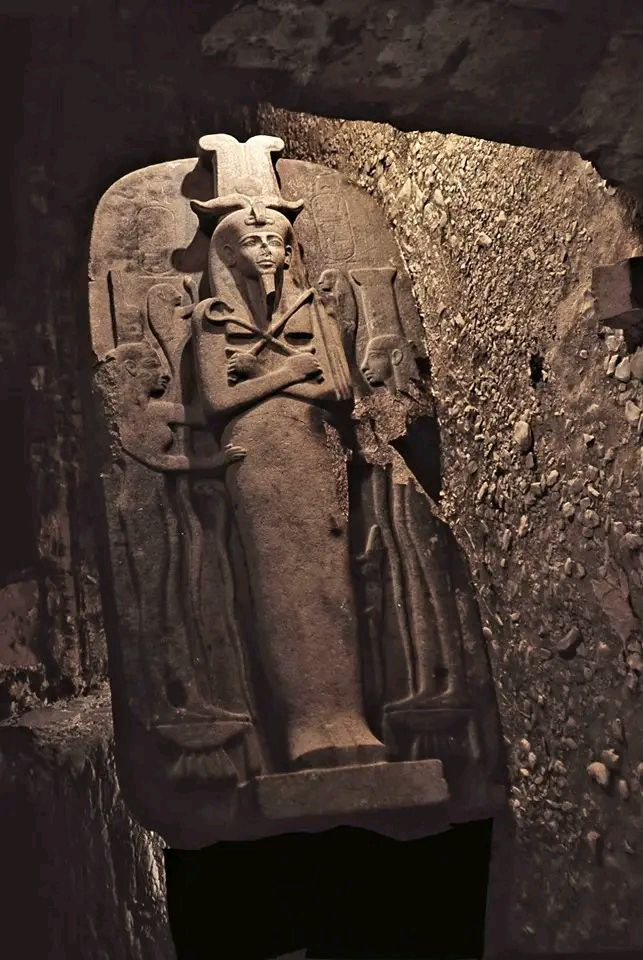
    Statue of Senusret I 
    He ruled Egypt for 42 years, and his son Amenemhat II shared his rule about two years before his death. King Senusret I was concerned with the external and internal situation of the country and its borders, whether south or north, and He sent missions to the south to exploit the gold mines there, and he also paid attention to the Sinai Peninsula to bring turquoise and copper. The economic situation improved during his reign, and among the most important temples he built was a temple to the sun god *Ra* *Atum* in the city of Ain Shams, which he built in the third year after his rule. Senusret I built his pyramid in the Lisht region south of the pyramid of his father, Amenemhat I. Archaeological remains from his era were found in no less than 35 archaeological sites spread between Alexandria and Nubia.


    Statue of King Senusret I in the white Hedjet crown of Upper Egypt

    Osiride statue of Senusret I

    The White Chapel of Senusret I at Karnak is a good example of
    the high quality of art produced during the 12th Dynasty.


    • King Senusret II ( 1897 - 1878 BC )
    The statue of Senusret II
    He is the son of Amenemhat II. He shared rule with his father for two years, and after that he ruled alone for 19 years. He followed his father's policies, whether internal or external, and it seems that he preferred, like his father, a life of peace. We did not find texts indicating that he waged wars of revenge in Africa or Asia. He was content with exploiting mines and quarries in Sinai and Wadi Hammamet He took care of the city of Fayoum and established irrigation projects there. He built his pyramid near Al-Lahun at the entrance to Fayoum. It seems that he did not care about the established traditions that were recognized by him in the Old and Middle Kingdom regarding the construction of the pyramid, as he made its entrance on the southern facade (which is often on the northern facade).With the death of this great king, a bright period of Pharaonic history ended in which the four kings of this dynasty united Egypt economically, socially, and politically. They tried their best to avoid wars with their neighbors, and the Pharaoh at that time had prestige everywhere.


    The Pyramid of Senusret II at El-Lahun


    Limestone slab showing the cartouche of Senusret II and the name and image of the goddess Nekhbet. From Mastaba 4, north side of Senusret II Pyramid at Lahun, Egypt. The Petrie Museum of Egyptian Archaeology, London.


    • King Senusret III ( 1878 - 1839 BC )
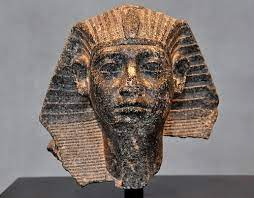
    He is the son of Senusret II and ruled Egypt for about 35 years, In it, he was able to eliminate the influence of the regional rulers after their wealth and influence increased, and after that they became employees, nothing more and nothing less Thus, the prestige of the ruling king returned to Egypt, and King Senusret III made a great effort to assert his authority over Nubia, as he launched four disciplinary campaigns It ended with Nubia's final annexation of Egypt. As for the northeast, Senusret also launched campaigns to strengthen the Sultan of Egypt, whether in Palestine or Syria. Senusret III died after building his pyramid in Dahshur, and Egypt was at the height of its glory and thanks to him it became safe from southern and eastern invasions. 


    King Senusret III


    Granite statue of Senwosret III - he is shown wearing the nemes headcloth with a cobra image of Wadjet at the front, the pleated shendyt kilt, and the bull's tail, visible between his legs; beneath his feet are nine bows, symbolizing Egypt's traditional enemies under his power; unlike his predecessors, who were shown with idealized facial features, Senwosret has heavily lidded eyes, lined and haggard cheeks, and pursed lips; the reason for this stylistic change is not known, but imitations of his features by later kings and private individuals suggest that Senwosret's features were intended to convey his virtuous qualities. Brooklyn Museum ( Wikipedia )


    The stela of Senusret III


    • King Amenemhat III
    Everything that his father, Senusret III, did, whether internally in terms of reforms or externally in terms of wars, had an impact on the life of prosperity and peace that his son Amenemhat III 
    Statue of Amenemhat III
    lived as king of Egypt, which lasted 45 years, all of which he devoted to economic aspects for the benefit of the country . He was interested in sending missions to the Sinai mines to exploit copper and turquoise, as more than 59 inscriptions recorded by the foremen there in his name and dating back to his era were found there. He also sent missions to the Wadi Hammamet quarries to extract basalt, to the Tura quarries to extract white limestone, and to Nubia to extract gold. He also paid attention to irrigation projects, where he reclaimed lands flooded with water and stored that water for use in times of drought. King Amenemhat III built two pyramids for him, the first in Dahshur and the second in Hawara near Fayoum. With the death of Amenemhat III, a bright period in the history of Egypt ended, and his son, King Amenemhat IV, assumed power after him, who ruled according to the Turin Papyrus for 9 years. We do not know exactly the period during which he shared the rule with his father, then his sister Sobekneferu came after him and ruled for three years, and her name was found on many antiquities dating back to this period. After that, the 12fth Dynasty and thus the Middle Kingdom collapsed.

    The pyramid of Amenemhat III at Hawara

    The Black Pyramid of Amenemhat III


    Newer Posts Older Posts Home

    Search

    Labels

    • Archaic Period
    • First Intermediate Period
    • Old Kingdom
    • 3rd Intermediate Period
    • Late Period
    • Middle Kingdom
    • 2nd Intermediate Period
    • New Kingdom

    ABOUT US

    This website explains the history of the kings of ancient Egypt and all information about the 30 Dynasties.

    POPULAR

    • Second Dynasty ( 2890 - 2686 BC )
    • First Dynasty ( 3100 - 2900 BC )
    Tasty Treats
    Travel Journal

    Translate

    Contact Form

    Name

    Email *

    Message *

    Designed by OddThemesGooyaabi Templates